
25-year Perspective
In the early years of IEA-OES, ocean energy was still a highly exploratory field. Wave and tidal stream technologies were attracting growing attention but remained largely at concept, model or prototype stage. Other ocean energy technologies, including OTEC and salinity gradient energy, were also being explored, each following a distinct development pathway with different technical challenges and potential applications. Tidal range energy, by contrast, had already demonstrated commercial-scale electricity generation.
Across the sector, long-term potential was widely recognised, but major uncertainties remained around technical reliability, costs and the route to market. Public support and private investment were beginning to increase, although they remained limited and uneven, and only a small number of technologies had accumulated substantial experience in real-sea conditions.
Over the past 25 years, progress has not been linear. Ocean energy has advanced through cycles of ambition, experimentation, setbacks, redesign and renewed effort. Many early concepts did not continue in their original form, some companies disappeared or were restructured, and several technologies proved more difficult to develop than initially expected. Yet this process of testing, learning and adaptation has been fundamental in building the technical knowledge, operational experience and infrastructure that support the sector today.
Wave energy: diversity as a defining characteristic
Wave energy illustrates this trajectory particularly clearly. Interest in wave power accelerated after the oil crises of the 1970s, and by the 1980s and 1990s a number of shoreline plants and early demonstration concepts had emerged. By the beginning of the 2000s, a first generation of dedicated developers was helping to bring wave energy into the public and industrial spotlight.
One of the defining features of wave energy at this stage was the remarkable diversity of technological concepts under development. Devices differed not only in their location - from shoreline to nearshore and offshore settings - but also in the principles by which they captured wave energy and the power take-off systems used to convert that motion into electricity.
The technology landscape of the early 2000s reflected this diversity. Oscillating water columns, oscillating bodies and overtopping devices were being explored in different fixed, floating and submerged configurations, with numerous approaches progressing in parallel.
This wide dispersion of concepts reflected both the creativity of the sector and the complexity of the wave resource itself. At the same time, it contributed to a more fragmented and experimental development path than that followed by tidal current energy.
Some projects progressed to full-scale construction and real-sea testing, while others remained at prototype stage or were later discontinued. Even when technologies did not continue in their original form, they generated valuable knowledge in areas such as hydrodynamics, power take-off systems, moorings, materials, installation and operation in demanding marine environments. Over time, a new generation of developers and research institutions increasingly incorporated lessons from this earlier experience. Progress has continued through sustained research, improved testing infrastructure and greater attention to survivability, reliability, maintainability and operations at sea. The diversity that characterised the early years therefore represents a period of intense experimentation, and important technical foundation for subsequent development.
Tidal range energy: an established but constrained pathway
Tidal range energy followed a very different trajectory. Long before the creation of IEA-OES, it had already demonstrated the ability to generate electricity at commercial scale. The La Rance tidal power plant in France, in operation since 1966, remains one of the landmark projects in ocean energy, while the later Sihwa Lake project in Korea provided another example of large-scale electricity generation from the rise and fall of the tides.
Despite this long operational history, tidal range energy has seen relatively limited deployment. Barrage projects require suitable geographical conditions and substantial infrastructure investment, while their potential environmental and social impacts can make planning and consenting particularly complex. More recently, tidal lagoon concepts have been explored as an alternative approach, although they have not yet progressed to widespread deployment.
Tidal range therefore occupies a distinctive place within ocean energy: it demonstrated large-scale electricity generation much earlier than other ocean energy technologies, but its expansion has remained constrained by geography, capital requirements and the characteristics of large civil-engineering projects.
Tidal current energy: towards greater convergence
Tidal current energy followed a distinct development path. In the early 2000s, the technology was also largely at prototype stage, with a growing number of developers exploring different approaches to extracting energy from energetic tidal flows.
Unlike wave energy, however, the sector gradually began to show greater technological convergence.
Early projects demonstrated that turbines could operate in real tidal environments and deliver electricity to the grid, while a growing industrial community emerged around the technology.
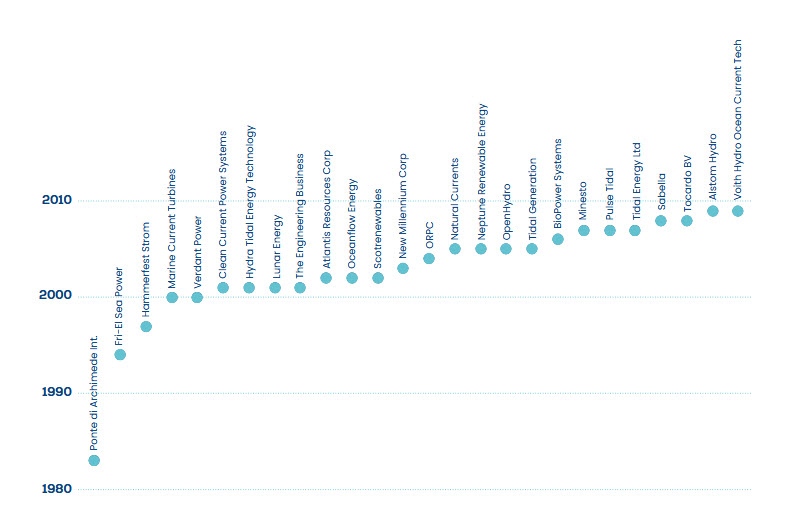
Foundation years of selected tidal current energy companies, illustrating the emergence and expansion of the sector’s industrial base
The foundation years of selected tidal current energy companies illustrate this expansion, from a relatively small number of early pioneers to a broader industrial base during the 2000s.
Over time, tidal current technology increasingly converged around more standardised turbine concepts. This growing degree of convergence allowed experience to accumulate more directly across projects and supported progress towards larger-scale demonstrations.
The sector has since demonstrated that multi-device arrays can operate successfully over extended periods. This progression has made tidal current energy one of the more technically advanced areas of the ocean energy sector and provides a clear contrast with the wider variety of technological approaches that continues to characterise wave energy.
Ocean Thermal Energy Conversion: from long-standing concept to renewed application
Ocean Thermal Energy Conversion followed a different trajectory again. The principle had long been recognised as promising, but for many years OTEC remained largely confined to pilot-scale research and feasibility studies.
In the early years of IEA-OES, the technology had therefore not progressed towards widespread deployment, despite the continued interest in its potential. Over time, advances in engineering, increasing interest from tropical regions and island territories, and greater recognition of benefits beyond electricity production gave OTEC renewed relevance.
A notable example of this evolution is Okinawa Prefecture’s OTEC demonstration facility on Kumejima Island, Japan. In operation since 2013, the facility has contributed practical experience while also demonstrating how deep seawater can support activities beyond power generation, including aquaculture and agriculture. This broader perspective is also evident in Sea Water Air Conditioning. Already a commercially proven application in several locations, it demonstrates how the thermal properties of the ocean can contribute to decarbonisation through cooling services.
The development of OTEC over the past 25 years therefore reflects a growing recognition that the ocean’s thermal resource can provide value through multiple applications, particularly in island and coastal contexts
Salinity gradient energy: from theory to practical demonstration
Salinity gradient energy was at an earlier stage of development at the beginning of the 2000s. Although the principle of generating energy from the interaction between fresh water and seawater was known, the technology remained largely within the research domain.
A major milestone came in 2009 with the opening of Statkraft’s prototype osmotic power facility at Tofte, Norway, the first of its kind in the world. The project demonstrated electricity generation from the pressure difference between fresh water and seawater and provided a practical platform for testing membranes, processes and system components. Although Statkraft later discontinued further investment in the technology, the Tofte project generated valuable operational knowledge and helped demonstrate the technical feasibility of osmotic power. Research has continued since then, with attention focused on improved membrane technologies and on opportunities to integrate salinity gradient systems with industrial processes, desalination and water treatment. Salinity gradient energy remains at an emerging stage, but its development over the past 25 years illustrates an important aspect of ocean energy innovation: progress is not measured only by commercial deployment, but also by the accumulation of technical knowledge, the
validation of new principles and the identification of new applications.
Different pathways, a shared process of learning
The evolution of wave, tidal current, OTEC and salinity gradient energy over the past 25 years shows that ocean energy is not a single technological pathway. Each resource has followed a different trajectory, due to its physical characteristics, technological requirements and potential applications.
- Wave energy has been characterised by diversity and continued experimentation.
- Tidal current energy has moved towards greater technological convergence and more advanced real-sea deployment.
- OTEC has combined long-standing technical interest with renewed attention to island applications and wider uses of deep seawater.
- Salinity gradient energy has progressed from largely theoretical development towards practical demonstration and continued innovation in membranes.
What these pathways share is a process of learning through experience. Prototypes, unsuccessful concepts, operational challenges and repeated testing have all contributed to a better understanding of how ocean energy technologies perform in practice. Over time, this accumulated experience has strengthened the sector’s engineering knowledge and increased confidence in the development and operation of these technologies.