
Today's Highlights
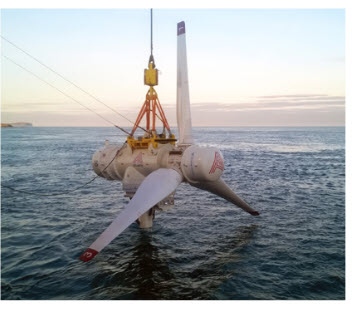 Meygen Tidal Energy Project, Scotland Meygen Tidal Energy Project, Scotland |
Twenty-five years after the creation of IEA-OES, ocean energy is entering a new phase. What was once driven primarily by vision, research and early experimentation is now increasingly defined by operational evidence, larger-scale ambitions and growing investor and policy confidence. Across tidal, wave, OTEC and other ocean energy applications, the sector is demonstrating that it can move beyond promise and deliver practical value.
Today, the challenge for ocean energy goes beyond demonstrating that technologies can operate at sea. It is about showing that they can perform reliably over time, be deployed at greater scale and make a meaningful contribution to the energy transition. Recent progress also reflects the development of more robust approaches to environmental assessment, maritime spatial planning and stakeholder engagement, creating stronger conditions for deployment and real-world impact
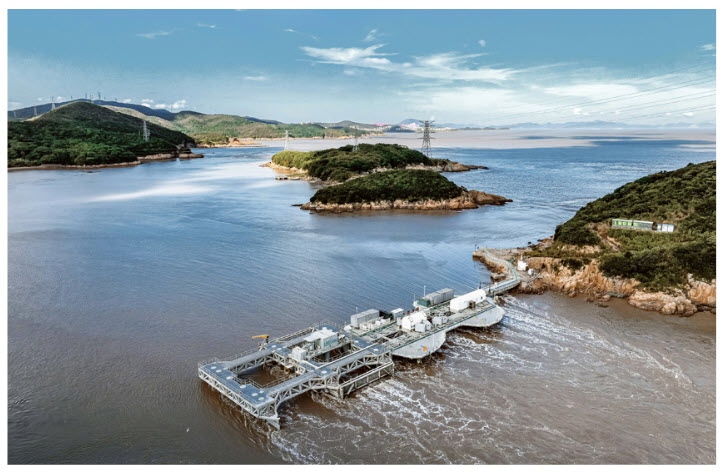
LHD Tidal Current Power Station, China
Proven reliability and operational confidence
Perhaps the most important signal of progress is the growing evidence from long-term operation
and cumulative electricity generation.
- In Scotland, MeyGen has continued to consolidate its position as the world’s reference tidal stream array, with cumulative generation approaching 75 GWh by the end of 2025 over 7 years of continuous operation.
- In China, the LHD Zhoushan project has demonstrated exceptional durability, with the “Endeavour” turbine surpassing 49 months of continuous operation.
- In Spain, the Mutriku wave power plant marked fifteen consecutive years of commercial operation in July 2026, generating electricity and delivering it to the grid. Together, these examples show that ocean energy is increasingly reliable under demanding real-sea conditions.
From single devices to multi-device deployment
Another defining characteristic of the sector today is the gradual but clear shift from isolated device demonstrations towards pre-commercial arrays and coordinated deployment strategies. This transition is essential: it signals that the industry is beginning to operate at the scale required for future market relevance.
In Portugal, CorPower Ocean advanced from the successful demonstration of its C4 unit to the
fabrication phase of the 10 MW VianaWave project, marking an important milestone for wave energy
scale-up. In the United Kingdom, Nova Innovation’s long-running Shetland array continues to
demonstrate how tidal energy can serve both local communities and wider grid applications.
In the Faroe Islands, Minesto’s Dragon 12 has reinforced the commercial potential of subsea kite
technology, while preparations for a 10 MW array point to the next stage of development.
Advancing engineering maturity
The sector is being shaped by technologies that are reaching increasingly high levels of engineering maturity, supported by improved design, extended operation in real-sea conditions and growing experience in installation, maintenance and performance assessment. Orbital Marine Power’s O2 is a leading example, having demonstrated the operation of a large-scale floating tidal turbine over an extended period.
Beyond electricity: supporting islands, remote communities and the blue economy Ocean energy is also proving its value beyond conventional grid supply. In many parts of the world, it offers solutions that respond directly to local needs, including freshwater production, thermal energy services and diesel displacement in remote or islanded systems.
In India, progress on ocean thermal applications for desalination highlights the importance of ocean energy for water and energy security in island communities. In Monaco, seawater-based heating and cooling systems continue to show how marine energy can contribute to decarbonisation in dense coastal environments.
In Singapore, Alaska and Canada, ocean and river current technologies are helping to shape more
sustainable microgrids, reducing dependence on imported fossil fuels and supporting more
resilient local energy systems.
A sector gaining strategic and policy credibility
The progress of recent years is also reflected in a broader shift in perception. Ocean energy is increasingly recognised both as a field of technical innovation and as a strategic option within the future clean energy mix. Major public support mechanisms, including EU Innovation Fund grants and the UK’s Contracts for Difference scheme, show that ocean energy is beginning to attract the kind of policy and financial backing associated with emerging investable sectors. This shift is part of a broader policy transition that has taken place over the past 25 years. Ocean energy has moved steadily from the margins of energy policy towards a more visible place in national and regional clean energy strategies. As highlighted in the IEA-OES policy report Technology Push & Market Pull, governments and public funding bodies increasingly recognise that ocean energy requires dedicated and well-sequenced support, combining research and innovation funding,
demonstration opportunities, and market frameworks tailored to the needs of the sector. Across a growing number of programmes, this transition can be seen in the emergence of ringfenced support, pilot deployment schemes, and longer-term revenue mechanisms. This reflects an important change: ocean energy has transitioned from a long-term research topic into a technology with strategic economic, industrial, and decarbonisation value. The opportunity is significant. The IEA-OES roadmap identifies
a potential contribution of 300 GW of ocean energy by 2050, with the capacity to create more than
680,000 jobs, generate over $340 billion in gross value added, and avoid more than 500 million
tonnes of carbon emissions. Realising this potential will depend on policy frameworks that support
the full innovation pathway, from early-stage R&D and testing infrastructure to demonstration, grid
integration and commercial deployment.
This does not mean that all barriers have been overcome. But it does mean that the sector is moving into a more mature phase, where confidence is built through evidence, partnerships and delivery. The foundations laid over the past 25 years are now supporting a new chapter — one in which ocean energy is increasingly positioned not at the margins of the energy transition, but as
part of its future.